

At TNV System Certification, we provide independent, third‑party assessment of your management system against the requirements of the relevant ISO standard. We do not design or operate your system for you – that remains your responsibility. Our role is to verify, through audit and objective evidence, that your system is effectively implemented and conforms to the standard and to our IAS accreditation rules.
This page explains how our certification process works from the first enquiry through to certification, surveillance and recertification.
Our Role as an IAS‑Accredited Certification Body
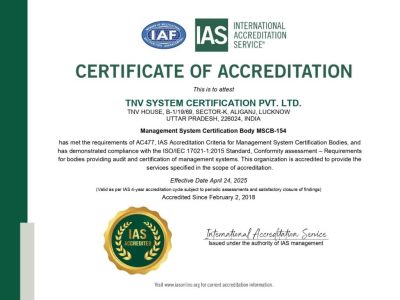
TNV System Certification is an IAS‑accredited certification body for selected ISO management system standards. As part of this role we are required to:
- Operate independently and impartially
- Follow ISO/IEC 17021‑1 and related sector‑specific competence standards
- Use competent auditors and technical experts
- Make certification decisions based solely on objective audit evidence
The steps below describe how we apply these requirements in practice for every client.
Step‑by‑Step ISO Certification Process Guide
1. Enquiry & Initial Discussion
You may contact us by email, phone, web enquiry form or through our authorised representatives. During this stage we:
- Understand your organisation, locations and activities
- Identify which ISO standard(s) you are interested in (e.g. ISO 9001, 14001, 45001, 27001, 22000, 50001)
- Clarify any regulatory or customer requirements and expected timelines
This information helps us determine whether your request falls within our accreditation scope.
2. Application & Scope Definition
You complete our ISO certification application form and provide basic information such as:
- Legal entity name, addresses and sites
- Number of employees / shifts
- Processes and products/services covered
- Applicable standard(s) and exclusions, if any
We review the application to:
- Confirm that the requested certification is within our IAS‑accredited scope
- Define the proposed scope of certification
- Estimate audit time in accordance with international rules
If additional information is needed, our team will request it at this stage.
3. Proposal, Contract & Audit Programme
Based on the application review, we issue a formal proposal outlining:
- Scope of certification
- Audit time and number of auditor‑days
- Proposed audit programme for the full certification cycle (initial certification + surveillance visits)
- Commercial terms and conditions
When you accept the proposal, both parties sign a certification agreement.
This agreement sets out the rights and responsibilities of TNV System Certification and your organisation, including confidentiality, use of marks, and rules for suspension or withdrawal.
4. Audit Planning
Once the contract is in place, we assign a competent audit team and plan the audits. Planning includes:
- Preparing an audit plan for Stage 1 and Stage 2
- Confirming audit dates, sites and key contacts
- Reviewing language, safety and access requirements
- Ensuring there is no conflict of interest between auditors and your organisation
You receive the audit plan in advance so that relevant personnel and records are available.
5. Stage 1 Audit – Readiness Review
The Stage 1 audit assesses your readiness for full certification. It can be performed on‑site or remotely, depending on the standard and circumstances.
Typical Stage 1 activities:
- Review of documented information (policies, procedures, records)
- Confirmation of the scope of certification and applicable processes
- Evaluation of the status of implementation and internal audits
- Identification of any major gaps that must be addressed before Stage 2
- Agreement of the Stage 2 audit plan and logistics
You receive a Stage 1 report highlighting any areas requiring attention. If significant gaps exist, Stage 2 may be postponed until you have taken corrective actions.
6. Stage 2 Audit – On‑Site Assessment
The Stage 2 audit is the main on‑site (or hybrid) assessment. The audit team evaluates:
- How your management system is implemented and maintained
- Conformity with the requirements of the ISO standard
- Evidence of effective planning, operation, monitoring and improvement
- Compliance with applicable legal and regulatory requirements related to the scope
The audit includes interviews, observation of activities, review of records and sampling across relevant functions and locations. Any nonconformities are documented and explained to you at the closing meeting along with agreed time frames for corrective actions.
7. Corrective Actions by the Organisation
If nonconformities are found, you are responsible for:
- Analysing the root cause
- Implementing appropriate corrective actions
- Providing objective evidence to TNV System Certification within the agreed timeframe
For some nonconformities, we may need to perform a follow‑up audit (on‑site or remote) to verify implementation. Our auditors do not prescribe specific solutions; they only verify the effectiveness of actions you choose.
8. Independent Certification Decision
After the audit and review of corrective actions, the complete audit package is sent to an independent technical reviewer / certification decision authority within TNV System Certification.
This person or committee:
- Reviews the audit reports and evidence
- Confirms that all requirements of the standard and our procedures are met
- Ensures impartiality and absence of conflicts of interest
- Makes the final certification decision
If the decision is positive, we prepare the certificate. If certification cannot be granted, we inform you in writing with reasons and guidance on the next steps.
9. Certificate Issuance & Use of Marks
Upon a positive decision:
- We issue an ISO certificate describing the certified standard, scope, locations and validity period.
- Your organisation is listed in our directory of certified clients.
- You receive rules for the use of the TNV System Certification and IAS accreditation marks, including how they may appear on stationery, websites and promotional material.
Misuse of marks or misleading claims can lead to suspension or withdrawal of the certificate.
Ongoing Surveillance & Recertification
Certification is not a one‑time event. To ensure ongoing conformity and effectiveness, TNV System Certification conducts surveillance audits and recertification:
Surveillance Audits
- Normally conducted annually (or as defined in the audit programme)
- Focus on key processes, management reviews, internal audits, corrective actions, legal compliance and continual improvement
- May be on‑site or use a combination of on‑site and remote techniques
Findings are reported in the same way as for the initial audit, and you are required to address any nonconformities.
Recertification Audit
At the end of the certification cycle (usually three years), a more comprehensive recertification audit is carried out to:
- Confirm the continued suitability, adequacy and effectiveness of the management system
- Review achievement of objectives, performance trends and improvements
- Decide on renewal of certification for a new cycle
A successful recertification leads to re‑issuance or extension of the certificate validity.
Changes, Suspension, Withdrawal and Appeals
During the certification cycle, the following situations may occur:
- Change of scope or organisation – If you add new products, processes or sites, or there are major changes in legal status or structure, you must inform us so we can review the impact on your certification and programme.
- Suspension or withdrawal – Certification can be suspended or withdrawn if serious nonconformities are not resolved, if audits cannot be performed, or if marks are misused.
- Appeals and complaints – You have the right to appeal certification decisions and to submit complaints about our services or about certified clients. We operate documented, impartial processes to investigate and resolve these matters.
Details of these processes are provided in separate policies available on our website and on request.
Your Responsibilities as a Certified Organisation
To maintain certification with TNV System Certification, your organisation is responsible for:
- Establishing, implementing and continually improving the management system
- Complying with the requirements of the relevant ISO standard and applicable legal obligations
- Conducting internal audits and management reviews at planned intervals
- Providing full and accurate information and access to our auditors
- Addressing nonconformities and implementing effective corrective actions
- Using certificates and marks in accordance with our rules
Our responsibility is to provide competent, impartial assessment and transparent decisions based on evidence.